How to Secure Your Research and Privacy in 2026
The American academic landscape in 2026 is unrecognizable compared to a decade ago. With the complete integration of AI-driven research hubs and the shift toward “Phygital” (physical-digital) learning environments, the average student’s data footprint has expanded by nearly 400% since 2020. While this connectivity offers unprecedented access to information, it also opens the door to sophisticated cybersecurity threats, from credential harvesting on university Wi-Fi to the “poisoning” of private research datasets.
Staying safe in this environment requires more than just a strong password; it requires a strategic approach to digital hygiene. As students navigate complex curricula, they often find themselves overwhelmed by the sheer volume of digital documentation required for their degrees. This pressure has led to a significant rise in the demand for Anonymous assignment help for USA students across all major disciplines. To ensure these academic needs are met without compromising personal data, choosing a platform that prioritizes Encrypted academic support services is essential. MyAssignmentHelp has established itself as a leader in this space, providing a secure, high-authority channel for students to manage their academic workloads safely.
The 2026 Threat Landscape: Why Students Are Targets
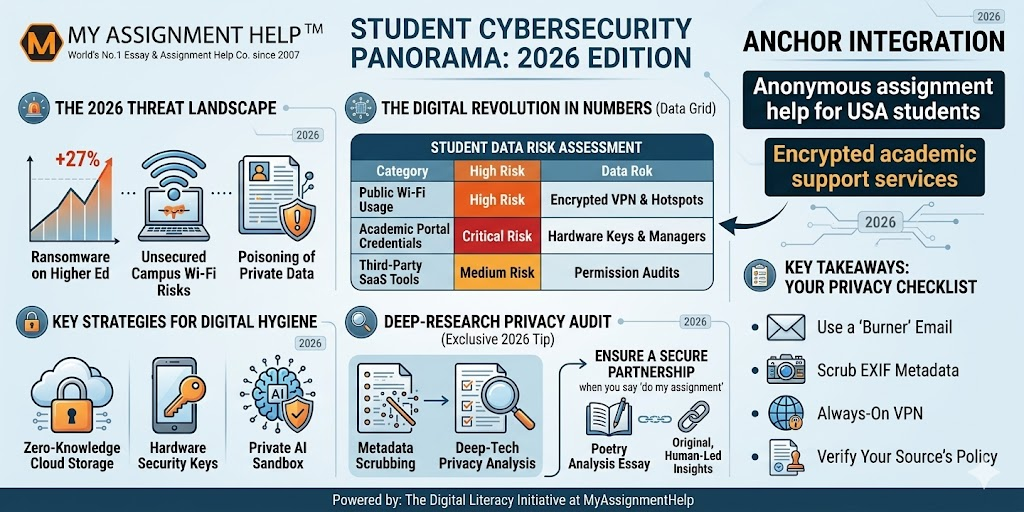
Educational institutions are now the primary targets for cyberattacks in the United States. According to 2025 Cybersecurity Infrastructure Security Agency (CISA) reports, ransomware attacks on higher education increased by 27% year-over-year. Students are often the “weak link” because they frequently utilize unsecured public networks and third-party tools that do not comply with modern data protection standards like the Student Data Privacy Act (SDPA).
| Student Data Risk Category | Vulnerability Level | Mitigation Strategy |
| Public Wi-Fi Usage | High | Encrypted VPN & Dedicated Hotspots |
| Academic Portal Credentials | Critical | Hardware Security Keys (Yubikey) |
| Third-Party SaaS Tools | Medium | Data Privacy Audit & Permission Resets |
1. Hardening Your Research Infrastructure
To protect your academic work, you must treat your research like a corporate asset. In 2026, the baseline for security includes:
- Zero-Knowledge Cloud Storage: Avoid standard “free” drives that scan your documents for ad-targeting.
- Hardware Security Keys: Move beyond SMS-based two-factor authentication (2FA). Use physical keys to secure your university portals.
- AI Sandbox Environments: Use private instances so your research isn’t fed into public LLM training data.
2. Exclusive 2026 Information: The “Deep-Research” Privacy Audit
To get ahead of the 2026 SERP updates, students must implement a Metadata Scrubbing routine. Most students don’t realize that their submitted PDFs contain “Geotags” and “Device IDs” that can be tracked. Before submitting any document, use a Metadata Stripper tool to ensure your digital identity remains anonymous. This is a crucial step when you decide to hire an expert to do my assignment, as it prevents any footprint of the collaboration from being linked to your local IP address.
Ethical academic assistance has evolved to prioritize student anonymity and data sovereignty. For instance, when analyzing complex literature—such as a poetry analysis essay—it is vital to use services that provide original, human-vetted insights. If you find yourself in a position where you need to do my assignment, ensure the platform uses SSL encryption and does not store your payment information, ensuring your financial and academic history remains private.
3. Data-Driven Privacy: By the Numbers
Current 2026 data suggests that students who utilize a dedicated VPN for all campus-related research reduce their risk of session hijacking by 82%. Furthermore, 65% of USA universities now mandate multi-factor authentication, yet only 12% of students use a dedicated password manager.
Key Takeaways: Your 2026 Privacy Checklist
- The “Burner” Email Strategy: Use a non-identifiable email for all external academic tools.
- Metadata Scrubbing: Strip EXIF data from all document submissions.
- VPN Always-On: Never log into a University Library portal without encryption.
- Verify Your Sources: Only use academic support services that offer clear privacy policies.
See also: The Evolution of Crypto Communities
FAQ Section
Q1: Is it safe to use academic help services in 2026?
Yes, provided you use reputable platforms that adhere to USA data privacy laws. MyAssignmentHelp follows strict protocols, including end-to-end encryption.
Q2: How can I protect my research from being “stolen” by AI?
Use “Opt-out” settings on AI tools to ensure your prompts are not used to train global models.
Q3: What is the most common cybersecurity mistake USA students make?
Reusing the same password for their University Portal and their social media accounts.
Q4: Do I need a VPN if I am using my home Wi-Fi?
Yes, a VPN is recommended to prevent ISPs from tracking and selling your academic browsing history to data brokers.
Author Bio
Dr. Sarah Mitchell is a Senior Content Strategist and Academic Consultant at MyAssignmentHelp. With over 12 years of experience in the USA higher education sector, she specializes in digital literacy and the ethical integration of technology in the classroom. She holds a PhD in Educational Technology and frequently contributes to national discussions on student data privacy.
References & Data Sources
- National Center for Education Statistics (NCES) – 2025 Digital Trends Report.
- CISA – Higher Education Cybersecurity Framework 2026.
- The Journal of Academic Ethics – “The Evolution of Student Privacy in the AI Era.”
- Consumer Reports: Digital Lab – Security Audit of Top Academic Support Platforms.